
 2 Camden Pl, Patrick’s Bridge,

Home > Latest News & Guides > Laser Hair Therapy for Men in Naas
Laser Hair Therapy for Men in Naas
Contact us today
Date added: 24/11/26
For many men it starts with a photograph. Somebody takes a picture from behind, or the light catches your temples in a certain way, and you see thinning that the bathroom mirror has been hiding.
Male pattern hair loss can begin early. The American Academy of Dermatology notes that it sometimes starts in the late teens or early twenties, so noticing it in your 20s or 30s does not make you unusual (AAD).
We understand that it can still feel isolating, particularly when friends of the same age have a full head of hair and every advert promises to fix yours in weeks.
At The Hair Clinic Naas, Low Level Laser Therapy (LLLT) is one of the non-surgical treatments we use for men. It is not laser hair removal, which is what most lasers advertised in Naas are for. Its purpose is to support the hair you still have.
This article will help you understand what laser therapy can and cannot do for a receding hairline and a thinning crown, what trials in men have found, and how to decide on your next step.
Key Takeaways
- Understand why male pattern hair loss shows first at the hairline and crown, and why other causes need to be ruled out.
- Learn what low level laser therapy can realistically offer at each area, and where its limits are.
- Discover what clinical trials in men have found, including the results that were less impressive.
- Know how laser therapy compares and combines with minoxidil, finasteride and FUE surgery.
- Find out what happens at a free assessment in Naas and how long a course of treatment takes to judge.
Table of Contents
- Why Men Lose Hair at the Hairline and Crown
- Laser Therapy for a Receding Hairline and Thinning Crown
- What Laser Trials in Men Have Found
- Laser, Medication or Surgery for Men
- Your Laser Treatment Plan in Naas
To find out what is happening at your own hairline or crown, book your free assessment at our Naas clinic.
Why Men Lose Hair at the Hairline and Crown
Losing some hair each day is normal. The HSE says that we can lose between 50 and 100 hairs a day, often without noticing (HSE).
Male pattern hair loss, also called androgenetic alopecia, is different. It is the most common cause of hair loss in men, and it usually appears as a receding hairline or a bald spot on the top of the head.
What men inherit is a sensitivity within the follicles to dihydrotestosterone (DHT), a hormone made from testosterone. Sensitive follicles gradually miniaturise, so each new hair grows finer than the last until growth eventually stops.
The temples and crown tend to be most sensitive to DHT, whilst the hair at the back and sides is usually spared. This is why the pattern is so recognisable. You can read more on our men's hair loss page.
Spotting the Change in Your 20s and 30s
Pattern hair loss tends to develop slowly, which makes it easy to miss. The Academy describes thinning that can continue for years.
At the front, you may see the corners drawing back or the hair at the temples becoming softer and finer. At the crown, the first clue is often a wider swirl, or more scalp showing under bright light.
Photographs are more reliable than memory. Take one from the front, one from each temple and one from above, in the same light and with dry hair, then repeat them every three months.
If you have noticed a change, our guide to preventing hair loss in your 30s explains the early signs and the habits that help. You do not need to wait for the thinning to become obvious to others before you ask.
When It Might Not Be Pattern Hair Loss
Not all hair loss in younger men is genetic, and treating the wrong condition wastes valuable time.
Telogen effluvium, for instance, causes more widespread shedding. The HSE lists illness, stress, weight loss and iron deficiency among its causes, and says that the shedding usually stops, or the hair grows back, after a few months.
Alopecia areata causes patches of loss, and the hair usually grows back. It needs a different approach from a gradual retreat at the temples.
Scalp problems can also confuse the picture. The HSE advises seeing a GP if you have itchy or sore areas of hair loss, if you are losing hair in clumps, if the loss is sudden or if you are worried about it. It also suggests talking to your GP before going to a commercial hair clinic, which is a sensible step and one we are happy to work alongside.
If you are not sure which description fits you, arrange a scalp analysis with our team.
Laser Therapy for a Receding Hairline and Thinning Crown
Laser hair therapy for men uses low level, non-thermogenic light. It does not work by heating the skin, and it is carried out for the opposite reason to laser hair removal.
The light is absorbed by the hair follicles and increases the production of ATP, the energy that cells use to grow. The process is also called photobiomodulation.
One principle applies wherever the thinning is. Laser therapy can only act on a follicle that is still there. It cannot regrow hair where the follicle has gone, so the state of the follicles matters more than your age or how long you have been worrying.
What to Expect at the Hairline
A receding hairline is often the first thing men ask us to fix, and it is where honest expectations matter most.
The hairline usually has two parts. There is the bare skin where hair used to grow, and there is the band of finer, shorter hairs just behind it. The second part is where laser therapy has something to work with.
For that reason, the aim at the front is to protect and thicken the hair that is still growing. It is not to redraw the hairline you had at 17.
If the corners have been smooth for a long time, no light-based treatment is likely to fill them. We would rather say so at your first visit than let you find out after months of sessions.
What to Expect at the Crown
Thinning at the crown is often more diffuse. Many fine, miniaturised hairs may remain among the thicker ones, even when the scalp has started to show through.
Where follicles are still producing hair, small improvements in thickness can add up to better coverage. Trials have also measured this area directly. One 16 week study took its hair counts from the centre of the vertex, which is the crown, and we look at its results below.
The crown is also hard to see for yourself. Men often underestimate thinning here, or only discover it when a barber or partner mentions it.
Under magnification we can compare the crown with the hair at the back of the head, which is usually spared. A clear difference in hair thickness between the two points towards active miniaturisation.
To see what is still growing in both areas, request a magnified scalp check in Naas.
What Laser Trials in Men Have Found
You will see bold percentages quoted for laser therapy online. We prefer to show you the studies and let you weigh them up.
A 2017 systematic review in the Journal of the American Academy of Dermatology pooled randomised trials of treatments for androgenetic alopecia. Low level laser therapy in men was superior to placebo, as were minoxidil and finasteride (Adil and Godwin, 2017).
The authors also pointed out that most of the studies varied a great deal from one another, which is a reason for caution about any single figure.
Results from Sham Controlled Studies
The strongest trials compare a real device with a sham that looks the same, so that neither the patient nor the assessor knows which one was used.
In trials of an FDA-cleared laser comb, 103 men were included in the final analysis. Over 26 weeks, terminal hair counts rose by between 18.4 and 25.7 hairs per square centimetre with the laser, depending on the model, compared with between 1.6 and 9.4 with the sham, and no serious adverse events were reported (Jimenez and colleagues, 2014).
The crown study mentioned earlier enrolled 60 men and women aged 19 to 65. At 16 weeks, hair density at the vertex had risen by 41.9 hairs per square centimetre with the active helmet, compared with 0.72 with the sham (Yoon and colleagues, 2020).
The Limits You Should Know About
Not every result is as striking. In a trial of 100 people, each treated with real light on one side of the head and sham light on the other, hair coverage after 24 weeks was 14.2% on the treated side and 11.8% on the sham side (Fan and colleagues, 2018). The difference was statistically significant, but it was modest.
A critical review of the evidence found small samples and wide variation between studies. It called for trials of 12 months and said that questions remain about the best regimen and about long-term maintenance (Gupta and Foley, 2017).
Most of these devices were designed for home use, so the figures should not be read as a forecast for a course of sessions in clinic. No treatment can promise a specific result, and we will not give you a percentage that we cannot stand behind.
To talk through what the evidence means for your own hair, speak to a specialist at our Naas clinic.
Laser, Medication or Surgery for Men
Laser therapy is one option among several. The right hair loss treatment for men depends on how far the thinning has progressed, your medical history and what you are prepared to keep up.
The Academy says that men who start treatment soon after noticing hair loss tend to see the best results.
It also makes a point that we agree with, which is that you do not have to treat this type of hair loss at all. Doing nothing is a valid choice, provided that it is an informed one.
Combining Laser with Minoxidil or Finasteride
A trial in 91 men compared light therapy three times a week with 5% minoxidil applied twice a day. Hair density improved in both groups over 6 months, with no significant difference between them (Neema and colleagues, 2025). Around a quarter of the men in the light therapy group showed no change, as did around 1 in 5 of those using minoxidil.
Using the two together may offer more. A 2025 meta-analysis of 7 randomised trials found that laser therapy with topical minoxidil increased hair density and thickness more than minoxidil alone, with no difference in adverse events (Mawu and colleagues, 2025).
Individual studies do not all agree. One trial of 54 patients found no significant difference after 16 weeks when twice weekly laser sessions were added to minoxidil (Sondagar and colleagues, 2023).
Finasteride works differently, by reducing DHT. The Academy says it has been shown to slow further hair loss in about 80% to 90% of men taking it. It also lists possible side effects, including loss of libido, erection problems, breast tenderness and depression, and notes reports of sexual side effects that continue after the medicine is stopped.
Finasteride therefore deserves a proper conversation with a doctor. Trichologists do not prescribe, so we liaise with your GP or an associated prescribing doctor. Our guide to what to do when minoxidil is not working may help if you have already tried it.
When FUE Is the Better Answer
Where the follicles have gone, surgery is the only one of these options that can place hair there. Follicular Unit Extraction (FUE) moves healthy follicles from one part of the scalp to another.
For younger men, timing needs careful thought. Pattern hair loss can continue for years, so a hairline placed too early may look out of step as the hair behind it continues to thin. A transplant does not stop that process in the surrounding hair.
That is why many plans begin with stabilising what remains. Our guide to FUE transplant density explains what surgery can achieve and what limits it.
Some men combine approaches, using non-surgical treatment for the crown and considering surgery for the corners later. Others find that slowing the change is enough to stop it bothering them.
If you would like to compare the options without pressure, arrange a private consultation in Naas.
Your Laser Treatment Plan in Naas
Every plan begins with a diagnosis. Nobody should commit to months of treatment on the strength of a quick look at the hairline.
Our clinic is discreetly located at 33 South Main Street. All consultations are private, and we see patients aged from 18 to 80.
If you have been looking for laser hair therapy in Naas and keep finding hair removal salons, our overview of laser hair therapy in Naas for thinning hair explains the difference in more detail.
Your Free Assessment and Scalp Analysis
Your free 30 minute assessment starts with your history. We ask when you first noticed a change, who else in the family is affected, what you have tried, and about your general health, diet and medicines.
Please mention everything you take, including supplements. Some medicines can contribute to hair loss, and others can make the skin more sensitive to light. Never stop a prescribed medicine without speaking to your doctor.
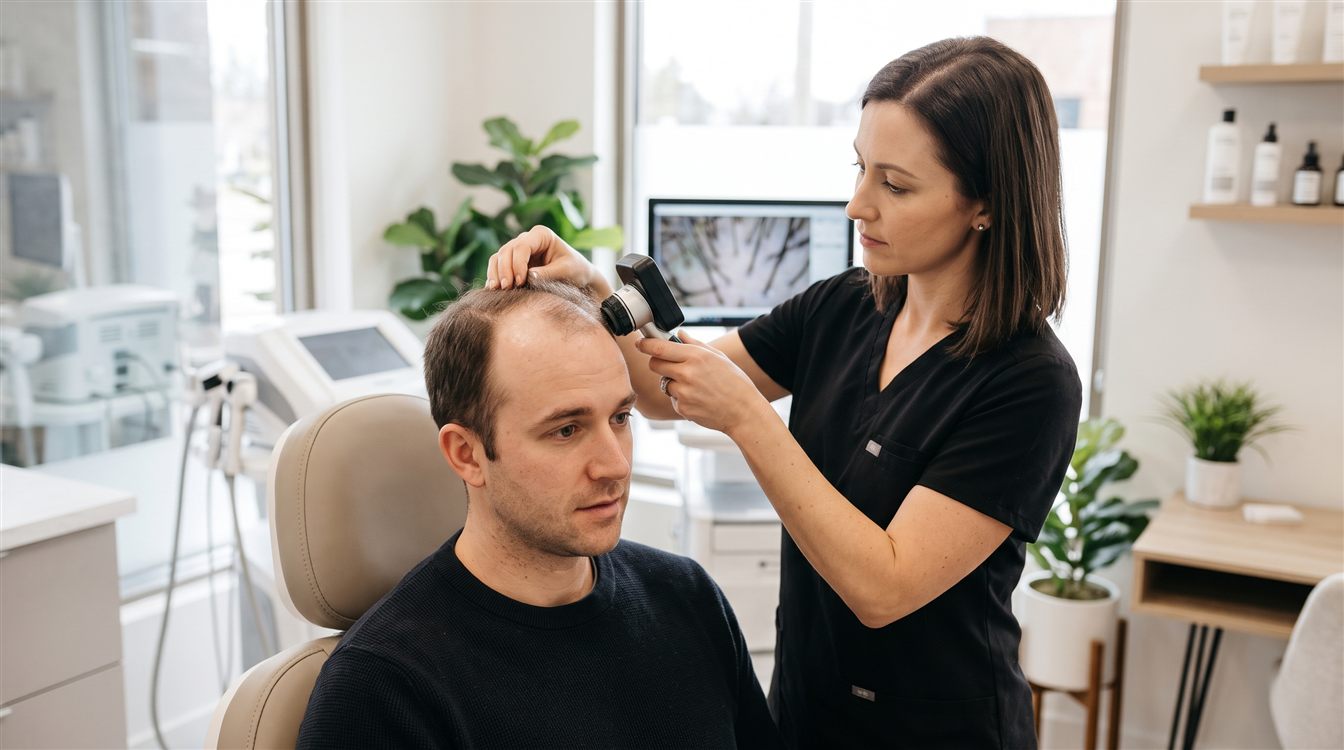
We then use digital trichoscopy to look at the hairline, crown and back of the scalp. This helps to show whether follicles are open, how much the hair thickness varies and whether there are signs of inflammation.
If blood tests would help, we work with your local GP. If we suspect a scarring condition, we refer you to a dermatologist. You are under no obligation to start treatment.
Bring photographs if you have them. Two or three pictures from the last few years can tell us more about the speed of change than a description can.
Sessions, Timelines and Tracking Progress
Laser sessions are painless, with no needles, no anaesthetic and no recovery time. You can go straight back to work, and nobody needs to know where you have been.
It usually takes between 3 and 6 months before patients start noticing results, with the best results seen after 9 to 12 months. Temporary shedding and an itchy scalp have been reported in laser research, so tell us if you notice either (Suchonwanit and colleagues, 2019).
We record magnified images at the start and at reviews, so progress is judged on evidence. Holding your ground is a worthwhile result too, as the alternative may have been further loss. Our guide to the signs of new hair growth after LLLT explains what to look for.
Pattern hair loss is long term, so maintenance is part of the plan.
Naas is around 20 minutes from Newbridge and Kildare town, 30 minutes from Athy, 35 minutes from Carlow and 50 minutes from Dublin. If you work shifts or commute, tell us, so that we can plan sessions you can realistically attend.
For a plan that suits your hair and your working week, reserve your assessment with our Naas team.
Start Laser Hair Therapy for Men in Naas Today
Noticing a receding hairline or thinning crown in your 20s or 30s can knock your confidence. Wanting to do something about it is not vanity.
Laser hair therapy for men in Naas is a painless option for male pattern hair loss, supported by several sham controlled trials. It is most useful whilst follicles are still active, and it works best as part of a plan built on a clear diagnosis.
The Hair Clinic opened in Cork in 2005 and was named the best trichology clinic in Ireland at the 2021 Republic of Ireland Prestige Awards. Our Naas clinic brings that experience to men across Kildare, Carlow, Wicklow and Co Dublin.
You will be told what we can see, what might help and what will not. If the honest answer is to wait, use medication first or consider surgery, that is the answer you will get.
Book your free hair and scalp assessment today, or call our Naas clinic on (045) 248018.
Frequently Asked Questions
Can laser hair therapy fix a receding hairline?
It may help to protect and thicken hair that is still growing along the hairline. It cannot regrow hair where the follicle is no longer present.
If the corners have been bare for a long time, FUE surgery may be the more realistic option. A scalp analysis will show which situation you are in.
Does laser therapy work on a thinning crown?
It can be a suitable option when the thinning is caused by male pattern hair loss and the follicles are still active. One 16 week trial measured hair density at the crown and found a greater increase with laser light than with a sham device.
Results vary between people and between studies, so we assess each scalp individually.
Am I too young for laser hair therapy in my 20s?
We see patients from the age of 18. Male pattern hair loss can begin in the late teens or early twenties, and men tend to see the best results when they start treatment soon after noticing it.
Being young does not mean that you need treatment, however. Sometimes the right plan is to record how your scalp looks now and check it again later.
Is laser hair therapy better than minoxidil for men?
A 2025 trial in men found no significant difference between light therapy and 5% minoxidil after 6 months. Both groups improved on average, although some men in each group saw no change.
A meta-analysis of 7 trials found that combining the two gave better hair density and thickness than minoxidil alone.
Can I use laser therapy instead of finasteride?
They work in different ways, so one is not a direct replacement for the other. Finasteride reduces DHT, whilst laser therapy supports the energy supply of the follicle.
If you are concerned about side effects, or already take finasteride, discuss it with your GP before making any change.
Does laser hair therapy have side effects in men?
No serious adverse events were reported in the laser comb trials in men. Temporary shedding and scalp itching have been reported in other research.
We review your medical history, your medicines and any sensitivity to light before recommending treatment.
How long will it take to see a difference?
It usually takes between 3 and 6 months before patients start noticing results, with the best results seen after 9 to 12 months.
We compare magnified images over time, because gradual change is difficult to judge in the mirror.
Do I need a referral to visit the Naas clinic?
No. You can book your free 30 minute assessment directly by calling (045) 248018 or using our contact form. The clinic is at 33 South Main Street, Naas, Co Kildare, W91 C9ER.
If your hair loss is sudden, or your scalp is itchy or sore, see your GP as well.
Disclaimer
Please note that the information provided is for general guidance only and should not be taken as professional advice tailored to your specific circumstances.
Find out if Laser Hair Therapy is right for you
At The Hair Clinic, we make managing thinning hair simple and stress free. No more worrying about which products to trust, as we do all the hard work for you. Our Cork & Waterfood teams are here to help you find the perfect, clinically proven treatment plan to suit your goals.
Want to know how laser therapy can stimulate growth and what kind of results you could expect?
No problem. Get in touch with our friendly team today to book your free consultation, and we’ll be happy to help.
Related Hair Treatment News & Guides
If you liked this guide then you may also like the following:
Professional Scalp Exfoliation in Waterford for Hair Preservation
A recent 2026 survey of nearly 1,500 women in Ireland revealed that hair thinning and loss is now the top concern for 28% of respondents...
Laser Hair Therapy in Naas for Thinning Hair
If you have searched for laser hair treatment in Naas, you will have noticed that almost every result is about laser hair removal.That is a very different...
Hair loss due to medication what to do and how to recover
What if the very prescription helping your body recover is the reason you are noticing more hair in the shower drain each morning?It is a distressing...

Expert Hair Loss Services in Cork for Men and Women
Did you know that over 80% of Irish men surveyed by DHI reported that hair loss has negatively impacted their self-confidence?It's a heavy burden to carry...
Professional Scalp Consultation for Hair Loss Cork and Clinical Analysis 2026
Did you know that 38.65% of men in Ireland are currently affected by baldness, whilst a 2025 survey revealed that over a quarter of women are deeply worried...
Laser Hair Therapy for Men in Naas
For many men it starts with a photograph. Somebody takes a picture from behind, or the light catches your temples in a certain way, and you see thinning...