
 2 Camden Pl, Patrick’s Bridge,

Home > Latest News & Guides > Laser Hair Therapy for Women in Naas and Kildare
Laser Hair Therapy for Women in Naas and Kildare
Contact us today
Date added: 23/11/26
You notice it in the bathroom mirror first. The parting looks a little wider than it did last year, the ponytail feels thinner, or there is more hair in the shower drain than there used to be.
Thinning hair affects women of all ages, yet it can be hard to talk about. We understand how upsetting it is to watch your hair change and not know why.
At The Hair Clinic Naas, we use Low Level Laser Therapy (LLLT) as one part of a treatment plan for women with the right type of hair loss. It is not laser hair removal, and it is not the right answer for every kind of shedding.
That second point matters. A widening parting, hair loss after a baby and thinning around the menopause can look alike, but they behave very differently and need different plans.
This article will help you understand where laser hair therapy for women in Naas and Kildare genuinely fits. You will learn what the research in women shows, when it is better to wait and what happens when you come to see us.
Key Takeaways
- Identify the difference between a widening parting, postpartum shedding and menopausal thinning, and why each one needs its own plan.
- Learn how low level laser therapy supports weakened follicles, and why it works on living follicles only.
- Understand what clinical trials in women have found, including where the evidence is still limited.
- Know when to wait, when to speak to your GP and when a scalp assessment in Naas is worth booking.
- Find out what a realistic treatment timeline looks like for women travelling from Newbridge, Kildare town, Athy or Carlow.
Table of Contents
- Why Women's Hair Thins Differently
- Laser Hair Therapy for a Widening Parting
- Hair Loss After a Baby and When to Wait
- Menopause, Hair Thinning and Where Laser Fits
- Your Treatment Plan at Our Naas Clinic
To have your hair and scalp looked at by a specialist, book your free assessment at our Naas clinic.
Why Women's Hair Thins Differently
Some shedding is perfectly normal. The HSE notes that we can lose between 50 and 100 hairs a day, often without noticing (HSE).
It becomes a concern when you shed more than is usual for you, or when the hair that grows back is finer and shorter than the hair that fell.
Women rarely lose all of their hair in the way that some men do. The American Academy of Dermatology explains that in female pattern hair loss the parting often gets wider, and that hair near the temples may recede (AAD).
Because the change is gradual and spread across the top of the scalp, it can go unnoticed for a long time. Women often adapt their styling first, changing the parting or tying the hair back, and only later ask why they need to.
Pattern Thinning or Temporary Shedding
Two of the most important causes to tell apart are pattern thinning and temporary shedding. Some women have both at the same time.
The first is female pattern hair loss, also called androgenetic alopecia. Follicles gradually miniaturise, so each new hair grows a little finer and stays for a shorter time. A Cochrane review describes it as the most common type of hair loss affecting women.
The second is telogen effluvium. Here, a trigger pushes more hairs than usual into the resting and shedding phase. Illness, stress, weight loss, low iron and having a baby are all recognised triggers.
The distinction shapes everything that follows. Pattern thinning is progressive and tends to continue without treatment. Telogen effluvium often settles once its trigger has passed. You can read more about both in our guide to sudden hair loss in women over 40.
Why a Scalp Analysis Comes First
It is very difficult to tell these conditions apart in a mirror. Under magnification, the picture is far clearer.
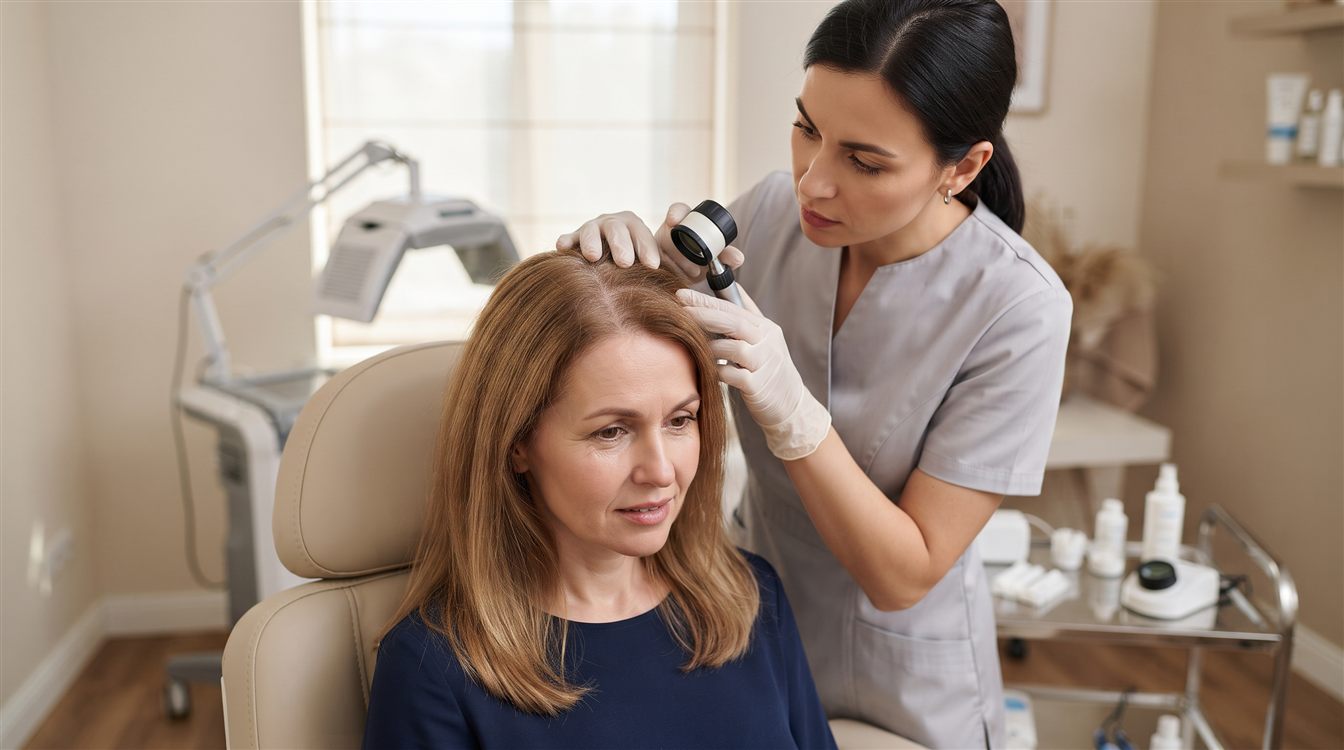
At our Naas clinic, digital trichoscopy allows us to examine your follicular openings and compare hair thickness across different areas of the scalp. A mix of thick and fine hairs along the parting points towards miniaturisation.
We also look for signs that need a different pathway. Frontal fibrosing alopecia, for example, can cause loss of the eyebrows and a receding hairline, and it is more common in women. It is a scarring condition, so we refer suspected cases to a dermatologist.
Finally, we ask about your general health. Low ferritin, thyroid changes and certain medicines can all play a part. Never stop a prescribed treatment without speaking to your doctor.
It also helps to bring a list of anything you already take or use, including supplements and topical products. The HSE advises that there is not enough evidence that vitamins and supplements work for hair loss, so we would rather look for a genuine deficiency than suggest you guess.
If you would like a clear answer about what is causing your thinning, arrange a scalp analysis with our team.
Laser Hair Therapy for a Widening Parting
A widening parting caused by female pattern hair loss is the situation in which laser hair therapy for women has the strongest rationale.
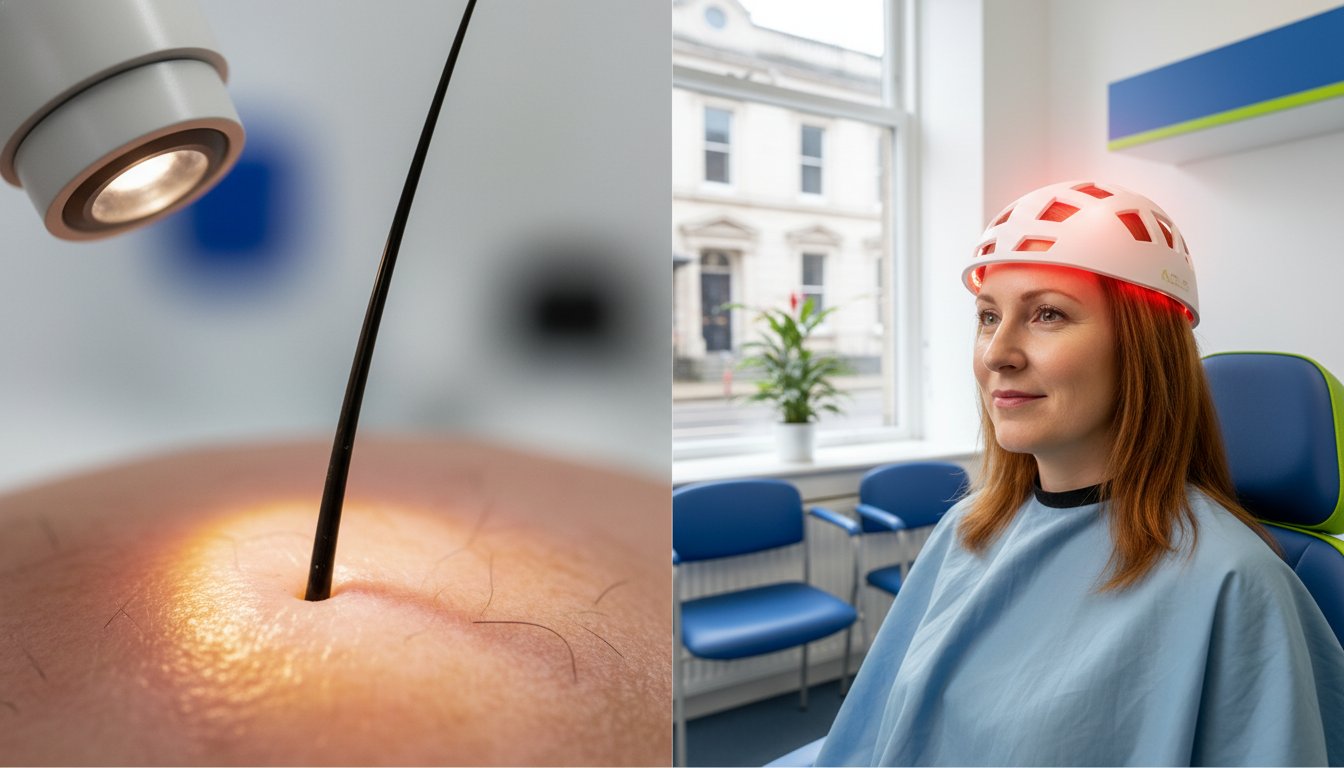
LLLT uses non-thermogenic light, which means it does not work by heating the skin. The light is absorbed by the hair follicles and increases the production of ATP, the energy that cells use to grow.
The aim is to support follicles that are weakened but still alive. It is completely different from laser hair removal, the treatment that dominates search results for lasers in Naas, and it is carried out for the opposite reason.
The treatment cannot regrow hair where the follicle is no longer present. This is why we encourage women to seek advice when they first notice a change in the parting, rather than waiting for the scalp to become obvious.
What the Trials in Women Have Found
Much of the early laser research was carried out in men, so it is reasonable to ask whether the results apply to you. Several trials have included women directly.
One set of randomised, sham-controlled trials tested an FDA-cleared laser comb used three times a week for 26 weeks. In the two female trials, terminal hair counts rose by around 20 hairs per square centimetre with the laser, compared with around 3 with the sham device. No serious adverse events were reported (Jimenez and colleagues, 2014).
A separate double-blind trial in women aged 18 to 60 used a helmet-style laser and LED device every other day for 16 weeks. In the 42 women who completed it, hair counts rose by 48% in the active group and 11% in the sham group, and no side effects were reported (Lanzafame and colleagues, 2014).
More recently, a systematic review of 38 studies found that hair density in androgenetic alopecia improved significantly with laser or LED therapy compared with placebo (Perez and colleagues, 2025). The vast majority of the 3,098 patients had pattern hair loss.
Where the Evidence Is Less Certain
You deserve the full picture, not just the encouraging parts.
The trials above tested home-use devices over 16 to 26 weeks, and some were small. A different device and treatment schedule may not give the same figures, and hair counts in a trial are not the same as the change you would see in the mirror.
A Cochrane review looked at two laser comb trials in 141 women. Hair counts improved more with the laser than with the sham comb, but the women themselves did not report clearly greater improvement (van Zuuren and colleagues, 2016). The review also rated only 5 of its 47 included trials, across all treatments, as being at low risk of bias.
We therefore present laser therapy as a well-studied option, not a certainty. No treatment can promise a specific result, and the HSE is equally clear that no hair loss treatment is 100% effective.
To find out whether your parting shows signs of active miniaturisation, speak to a specialist in Naas.
Hair Loss After a Baby and When to Wait
Few things are as alarming as handfuls of hair coming away just as you are adjusting to life with a newborn.
The reassuring news is that postpartum hair loss is usually temporary. The HSE describes hair loss after giving birth as a telogen effluvium, caused by a rapid change in hormone levels that moves hair from its growth phase to its shedding phase.
The American Academy of Dermatology says shedding can begin about two months after birth and usually peaks at around four months. Most women see their hair return to its normal fullness by their child's first birthday (AAD).
For most new mothers, then, the right treatment is time. We would not start a course of laser therapy for straightforward postpartum shedding that is expected to settle on its own.
Caring for Your Hair While You Wait
The HSE states that telogen effluvium after birth usually resolves after 3 to 6 months and that you do not need treatment (HSE). It recommends a healthy diet, including foods that contain iron and protein.
Your GP may suggest blood tests to check your iron and thyroid levels. These are worth discussing if you feel unwell or if the shedding seems excessive.
Be gentle with your hair in the meantime. Tight ponytails and buns place tension on the hairline, which can damage the follicles over time.
Take care with medicated products too. The American Academy of Dermatology advises avoiding minoxidil if you are pregnant, planning a pregnancy or breastfeeding. A 2026 review took a different view on topical use while breastfeeding, though not during pregnancy (Maas and colleagues, 2026). Ask your GP or pharmacist before you apply anything.
When Shedding Has Not Settled
Sometimes the hair does not recover as expected. The same 2026 review lists pattern hair loss, as well as telogen effluvium, among the common causes of hair loss in the months after birth, so it is worth checking for both.
The Academy suggests seeking advice if your hair has not regained its normal fullness after one year. You do not need to wait that long if you are worried, if you notice distinct patches or if your scalp is itchy or sore.
The evidence for using laser therapy in telogen effluvium itself is very limited. In the 2025 review of 38 studies, only 17 of 3,098 patients had the condition, which was too few to draw conclusions from.
If a scalp analysis shows that pattern hair loss is also present, laser therapy can be considered for that. If it does not, we will tell you honestly that you are better to wait.
If your hair has not recovered after having a baby, ask our Naas team for an assessment.
Menopause, Hair Thinning and Where Laser Fits
The average age for a woman in Ireland to reach menopause is 51, and symptoms can begin 7 to 10 years before periods stop (HSE).
For some women, changes in the hair are a distressing part of that transition. The texture alters, the parting widens and the volume that used to be taken for granted is gone.
Hair is not the only thing changing at this time. Sleep, work, family and health can all feel unsettled, and it is easy to put your own concerns last. There is nothing vain about asking for help.
How Hormonal Change Affects the Follicle
The hair follicle is sensitive to oestrogen. A 2025 review explains that the fall in oestrogen and the relative increase in androgens can reduce hair density, make individual hairs finer and change their texture (Gupta and colleagues, 2025).
The same review notes that female pattern hair loss, telogen effluvium and frontal fibrosing alopecia have all been seen more often in women after the menopause.
That does not mean the menopause explains every case. Family history, low iron, thyroid problems, illness and stress related hair loss can all overlap with it, which is why we look at the whole picture.
It is also why a diagnosis matters more, not less, at this stage of life. Frontal fibrosing alopecia in particular needs prompt medical referral, because hair lost to scarring cannot be brought back with light.
You may find it useful to look back over old photographs before your appointment. A slow change over several years suggests a different cause from a sudden change over a few months, and those details help us to ask better questions.
Laser Therapy as Part of a Wider Plan
Where menopause hair thinning is due to female pattern hair loss, laser therapy can form part of a wider plan. It works in a different way from medication, so the two can be used together.
A 2025 meta-analysis of 7 randomised trials found that laser therapy combined with topical minoxidil gave a greater increase in hair density and thickness than minoxidil alone, with no difference in adverse events (Mawu and colleagues, 2025). This covered androgenetic alopecia in general and was not limited to menopausal women.
Trichologists do not prescribe, so where a prescription treatment may help, we liaise with your GP or an associated prescribing doctor.
If minoxidil alone has disappointed you, it may be a question of diagnosis or timing. A scalp analysis can help to show which.
Questions about hormone replacement therapy belong with your GP, who can weigh up your full medical history. We are happy to work alongside whatever you decide together.
To talk through menopausal thinning in complete confidence, contact our Naas clinic.
Your Treatment Plan at Our Naas Clinic
Every woman who comes to us starts in the same way, with a conversation and a proper look at the scalp. Nothing is recommended until we know what we are treating.
Our clinic at 33 South Main Street is discreet, and all consultations are private. We see patients aged from 18 to 80, so you will not be too young or too old to ask.
Your Free Assessment and Local GP Support
Your free 30 minute assessment covers your hair loss history, general health, medicines, diet and family pattern. Digital trichoscopy then shows us how your follicles are behaving.
Where needed, we work with your local GP on blood tests. Ferritin, thyroid function and a full blood count are common starting points, and your GP can advise on what is appropriate for you.
If laser therapy suits you, we will explain why. If your hair loss is likely to recover without it, or needs a dermatologist, we will explain that instead.
Sometimes the most useful outcome is reassurance. If your shedding looks temporary, we can record how your scalp looks now, suggest when to check it again and leave you with one less thing to worry about.
You can learn more about the conditions we see on our women's hair loss page, or read our guide to laser hair therapy in Naas for a general overview.
Sessions, Timelines and Realistic Expectations
Laser sessions are painless and need no needles, anaesthetic or recovery time. You can return straight to work or the school run afterwards.
Patience is essential. It usually takes between 3 and 6 months before patients start noticing results, with the best results seen after 9 to 12 months. We review your progress with magnified images, so that you are not relying on memory.
Temporary shedding and scalp itching have been reported in laser trials (Suchonwanit and colleagues, 2019). Our guide to laser hair therapy side effects for women covers safety and the conditions we screen for.
Pattern hair loss is long term, so results need to be maintained. We will plan that with you from the start rather than leaving it as a surprise.
Travel is a fair consideration as well. Naas is around 20 minutes from Newbridge and Kildare town, 30 minutes from Athy and 35 minutes from Carlow. If regular visits are difficult, tell us at your assessment so that we can discuss your options.
For a plan built around your hair and your schedule, reserve your consultation in Naas.
Start Laser Hair Therapy for Women in Naas Today
Thinning hair can affect how you feel every day, and it is easy to dismiss it as something you simply have to accept. Often, there is more that can be done than you think.
For female pattern hair loss, laser hair therapy for women in Naas and Kildare is a painless option with encouraging trial evidence. For postpartum shedding, time is usually the best treatment. For menopausal thinning, a careful diagnosis decides which path is right.
The Hair Clinic opened in Cork in 2005 and was named the best trichology clinic in Ireland at the 2021 Republic of Ireland Prestige Awards. Our Naas clinic brings that experience to women across Kildare, Carlow, Wicklow and Co Dublin.
We understand how personal this is. You will be listened to, given honest advice and left to decide in your own time.
Book your free hair and scalp assessment today, or call our Naas clinic on (045) 248018.
Frequently Asked Questions
Does laser hair therapy work for women?
Trials in women with female pattern hair loss have found greater increases in hair counts with laser devices than with sham devices.
Results vary from person to person, and the women in two of those trials did not clearly report a greater improvement than the sham group, even though hair counts rose. A scalp analysis is the best way to judge whether you are likely to be a suitable candidate.
Can laser therapy fix a widening parting?
It may help to improve density where the parting is widening because of female pattern hair loss and the follicles are still active.
It cannot regrow hair where the follicle is no longer present. Other causes of a wide parting need different treatment, so a diagnosis comes first.
Should I have laser hair therapy for postpartum hair loss?
Usually not. The HSE says hair loss after giving birth usually resolves after 3 to 6 months and does not need treatment.
If your hair has not recovered by your child's first birthday, or you are worried sooner, book an assessment or speak to your GP.
Can laser hair therapy help with menopause hair loss?
It can be considered when thinning around the menopause is caused by female pattern hair loss. It is often used alongside other treatments.
It is not suitable as a treatment for scarring conditions such as frontal fibrosing alopecia, which need a dermatologist.
Is laser hair therapy safe for women?
No serious adverse events were reported in the female laser comb trials. Temporary shedding and scalp itching have been reported in other research.
We review your medical history, medicines and any light sensitivity before recommending treatment.
Which blood tests should I ask my GP about?
Ferritin, thyroid function and a full blood count are common starting points when a woman has unexplained shedding.
Your GP will decide what is right for you, and may add others based on your symptoms and history.
How long does laser hair therapy take to work?
It usually takes between 3 and 6 months before patients start noticing results, with the best results seen after 9 to 12 months.
We review your progress with magnified images at the clinic, so that changes can be compared fairly over time.
Do I need a GP referral to visit the Naas clinic?
No. You can book your free 30 minute assessment directly by calling (045) 248018 or using our contact form.
If your hair loss came on suddenly, or your scalp is sore or itchy, the HSE advises seeing your GP. You can do this as well as booking with us.

Disclaimer
Please note that the information provided is for general guidance only and should not be taken as professional advice tailored to your specific circumstances.
Find out if Laser Hair Therapy is right for you
At The Hair Clinic, we make managing thinning hair simple and stress free. No more worrying about which products to trust, as we do all the hard work for you. Our Cork & Waterfood teams are here to help you find the perfect, clinically proven treatment plan to suit your goals.
Want to know how laser therapy can stimulate growth and what kind of results you could expect?
No problem. Get in touch with our friendly team today to book your free consultation, and we’ll be happy to help.
Related Hair Treatment News & Guides
If you liked this guide then you may also like the following:
Best Non Surgical Hair Loss Treatment for Men in Cork 2026
What if the window to save your hair is closing faster than you realise?For many men across Ireland, the first sign of a receding hairline or a thinning...
Hair Loss Clinic Near Me in Cork and Waterford for Professional Restoration
Have you ever looked in the mirror and wondered if the person staring back is losing more than just their hair?For many people across Cork and Waterford...
Best Treatment for Alopecia Areata Waterford and Clinical Recovery Paths
What if those sudden, circular patches appearing on your scalp aren't a permanent sentence of hair loss, but rather a biological signal that your follicles...
Professional Laser Hair Treatment in Waterford
What if the reason your hair growth has stalled isn't just down to genetics, but a physical barrier resting directly on your skin?It's deeply frustrating...
Women’s Hair Loss Specialist Waterford | Expert Clinical Solutions in 2026
Did you know that 28% of women in Ireland now rank thinning hair as their primary beauty concern, even above dryness or breakage?If you have spent your...

Female Pattern Hair Loss Treatment in Waterford for Clinical Restoration
Did you know that 28% of women in Ireland now rank thinning hair as their primary beauty concern?It's a distressing experience to look in the mirror...